

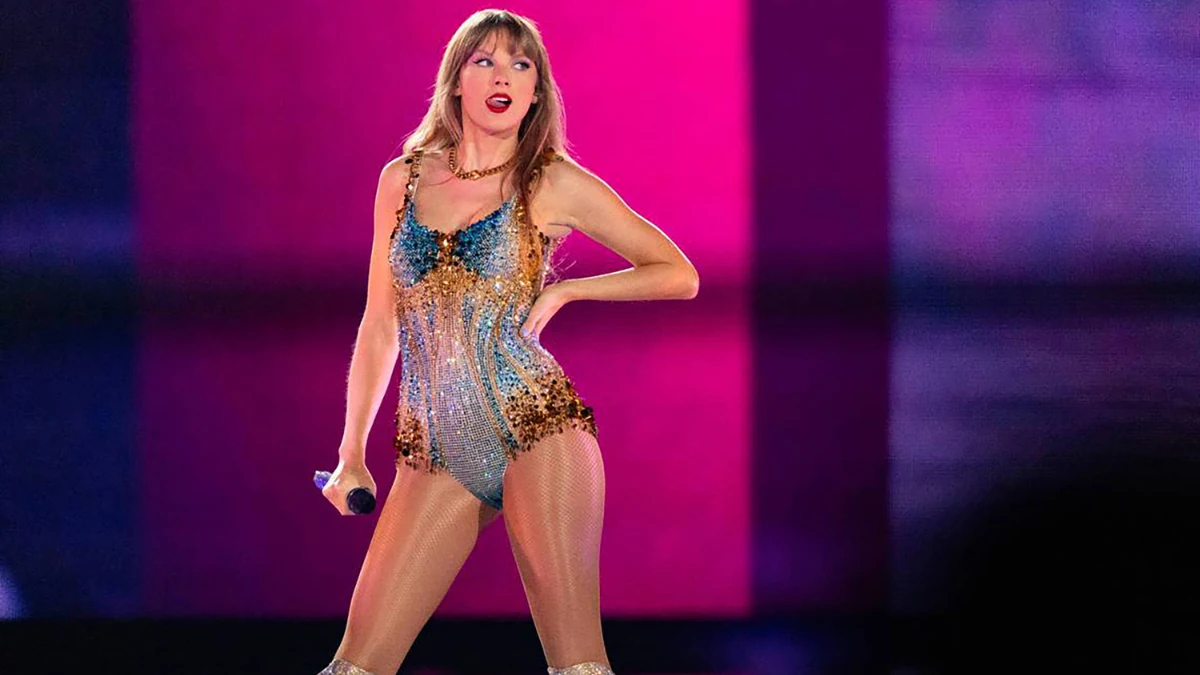
Taylor Swift takes a stand against AI: the singer trademarks her voice and image.
The artist requests protection of distinctive elements of her identity to stop imitations and deepfakes.
In a context marked by the rise of AI-generated content, American singer Taylor Swift has initiated legal proceedings to protect her voice and image by registering trademarks.
Taylor Swift has filed several applications with the United States Patent and Trademark Office to strengthen control over the use of her identity. Specifically, the process includes three trademarks: two sound-based trademarks, based on phrases associated with her voice, and a third focused on a photograph of the singer during the Eras Tour.
This measure responds to the exponential growth of AI-generated content that replicates the voices and images of public figures without authorization. In recent years, Swift has been the target of such practices, from manipulated images to fake messages simulating her participation in political and promotional campaigns.
Taylor Swift vs. AI: Trademark Registration as a Protective Measure
Unlike traditional mechanisms such as copyright or image rights, trademark registration offers an additional avenue for legal action against imitations that are «confusingly similar.» This distinction is especially important at a time when technology allows for the creation of new content without directly copying existing materials. This situation creates legal loopholes that are very difficult to address with traditional tools.
In this context, Taylor Swift’s move is not isolated. Actor Matthew McConaughey initiated a similar process in early 2025, successfully registering multiple elements related to his voice and audiovisual presence. Both cases reflect a shift in how celebrities seek to protect their identity in the digital age.
Furthermore, one of the applications filed by the singer stands out for its focus on a specific visual aesthetic: an image of the artist with a guitar and distinctive attire, closely linked to her recent concerts. This type of performance could broaden the possibilities for legal protection against digital recreations that imitate not only the artist’s image but also their stage presence.
Until now, registering one’s voice as a trademark was an uncommon practice in the entertainment industry. Taylor Swift’s decision highlights the need to adapt legal tools to a context in which artificial intelligence can replicate anyone’s identity with great accuracy. Thus, industry protection mechanisms are undergoing a complete redefinition, and are particularly vulnerable in the new era of generative AI.
Source: www.marketingdirecto.com