Microsoft redefines advertising with AI and automated decisions
New features in Microsoft Advertising: AI, automation, and agents that transform how campaigns are created, measured, and optimized.

Microsoft has unveiled a new set of updates to its advertising ecosystem, reinforcing its commitment to artificial intelligence, automation, and adaptation to a new digital landscape where agents are increasingly making decisions on behalf of users.
The announcements, integrated within the latest Microsoft Advertising updates, include improvements to Performance Max, new measurement capabilities in Microsoft Clarity, and advancements in commerce and ad automation with AI Max and new audience generation tools.
Performance Max: More Automation and Greater Transparency
One of the most significant announcements is the expansion of Performance Max (PMax) campaign capabilities, which can now be imported directly from Google Ads with New Customer Acquisition (NCA) objectives.
This functionality, now available to all advertisers, allows for the transfer of campaigns optimized for acquiring new users without losing existing Microsoft Advertising settings. Furthermore, the system automatically adapts imported audiences, converting Google visitor lists into equivalent segments within the Microsoft ecosystem.
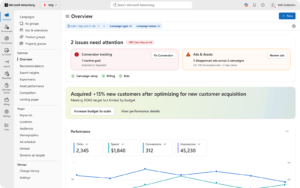
The company has also introduced key improvements to the transparency of these campaigns with the arrival of landing page reports, which allow for analysis of performance by final URL using metrics such as clicks, impressions, revenue, and ROAS.
Another significant change is the default display of search terms, reinforcing the goal of providing greater clarity on how campaigns are being triggered.
In addition, Microsoft has expanded the use of seasonality adjustments to portfolio bidding strategies and increased the campaign name limit to 400 characters, facilitating large-scale management.
Advertising in the Age of AI Agents
Beyond operational updates, Microsoft has framed these changes within a deeper transformation: the transition to what it calls the three eras of the web.
According to the company, users already interact in parallel with three environments: the traditional search web, the language model web, and a new «agent web,» where AI systems make decisions and execute actions on behalf of users.
In this context, automated traffic is already growing eight times faster than human traffic, and AI-driven sessions have tripled in the last year.
This shift is forcing brands to move beyond optimizing solely for humans and start becoming «eligible» for AI systems that select, compare, and decide.
Microsoft Clarity Expands AI Visibility
To adapt to this new environment, Microsoft has expanded the capabilities of Microsoft Clarity with new AI visibility features.
These tools allow advertisers to understand how artificial intelligence systems interpret their content, which pages are cited in AI-generated responses, and how they rank against the competition.
The evolution of this functionality will also incorporate automated recommendations to identify content gaps, which pages are cited in AI-generated responses, and how they rank against the competition.
Source: www.marketingdirecto.com