


YouTube and Google dominate global influence: this is how brands will conquer media and networks in 2026
YouTube, Google and Instagram lead the ranking of the most influential brands in 2026 according to Onclusive, dominating media and social networks.

YouTube, Google, and Instagram are the three most influential brands in the world in media and social networks in 2026, according to the «Brand Influence 2026» ranking compiled by Onclusive, a media intelligence company.
The report, presented during the Onclusive on the Road event held in Madrid, confirms what the market already suspected: that technology brands, in addition to leading the conversation, have also transformed their media presence into a competitive advantage that is difficult to replicate.
The snapshot of the global top 10 is particularly revealing, considering that after YouTube, Google, and Instagram come Facebook, LinkedIn, Apple, Amazon, Microsoft, TikTok, and ChatGP, in a ranking almost entirely dominated by digital giants and companies closely linked to the rise of artificial intelligence.
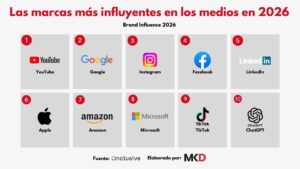
Technology Dominates More Than Half of the Top 50
The tech sector’s dominance extends far beyond the podium. Looking at the top 50, more than half of the most influential brands belong to the technology sector, with 28 representatives, far surpassing other sectors like banking and consumer goods, which each have seven brands.
According to Onclusive, this leadership stems from a structural advantage in generating coverage across both media and social networks, something that consumer goods or service brands find more difficult to sustain over time.
However, the report offers a point for reflection: no brand in the top 10 simultaneously dominates all the analyzed channels.
For example, Instagram and Facebook excel in media but show more moderate performance on social networks, a striking paradox for two of the most social platforms on the planet. In contrast, Microsoft and LinkedIn exhibit the opposite behavior, with a greater presence in the social and professional spheres.
On the other hand, beyond the volume of conversation, the study focuses on another key factor: brand sentiment. In this area, LinkedIn stands out with 70% positive sentiment, a figure that propels the company to fifth place in the ranking.
The opposite is true for Facebook, which, although it maintains a strong media presence, barely exceeds 50% positive sentiment, an aspect that, according to the analysis, hinders its progress.
Finance, luxury, and automotive also have a strong presence
Although technology dominates the ranking, other sectors maintain a significant presence. In the financial sector, seven brands appear in the ranking, including Bank of America, Wells Fargo, JP Morgan, Morgan Stanley, and Mastercard.
For its part, the consumer sector also has seven representatives, with luxury brands playing a particularly prominent role: Louis Vuitton, Chanel, and Hermès are among the most influential brands, along with giants like L’Oréal, Coca-Cola, Adidas, and Nike.
In the automotive sector, the top-ranked brands are Tesla, Mercedes-Benz, and Toyota, positioned between 13th and 17th place, while in retail, Walmart, Ikea, and McDonald’s stand out. The top 50 is rounded out by such recognizable names as Netflix, Disney, Aramco, and Hilton.
Influence no longer depends on a single channel.
According to Onclusive, the top-ranked brands share the same formula: they don’t build relevance through a single metric or channel.
True influence stems from combining media volume, positive sentiment, CEO visibility, professional engagement, and organic social conversation.
In the words of Rafael Sánchez, Head of Sales at Onclusive, “Leading brands, such as YouTube, Google, and Instagram, don’t top the rankings solely because of their marketing budgets, but because they have built a consistent, high-volume, and predominantly positive presence across every layer of the media landscape.”
Source: www.marketingdirecto.com


