


«ChatGPT Health» arrives: a chatbot that answers medical questions
OpenAI’s new tool interprets users’ medical data, without replacing healthcare professionals and with privacy as its central focus.

OpenAI presents «ChatGPT Health,» a new tool within ChatGPT designed to help people better understand their medical information based on their own data. Among the initiative’s main objectives are strengthening user privacy and data protection, and not replacing professional medical care. The launch marks a significant step for the company in the growing consumer digital health market.
Health is already one of the most popular topics on ChatGPT. Every week, hundreds of millions of people use the assistant to resolve questions related to wellness and personal care. The new tool channels these questions to offer context, clarity, and preparedness to each user.
Through the platform, you can securely connect your medical history so that conversations are based on your own medical information. ChatGPT Health then uses this data to offer more personalized answers based on your health, providing the most relevant, accurate, and useful information. Furthermore, the tool was developed in collaboration with healthcare professionals to help people actively participate in their health care, without replacing the various experts in the healthcare sector.
On the other hand, ChatGPT Health combines robust privacy, security, and data management controls with additional protections specifically designed for health, including encryption and isolation that keep conversations private and compartmentalized.
ChatGPT Health: AI as a personal medical assistant
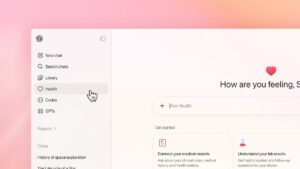
Unlike typical chat apps, this tool operates in a separate section of the platform, where users can securely integrate their electronic health records and wellness apps such as Apple Health, MyFitnessPal, Peloton, or Weight Watchers.
Based on this information, the system can help you interpret your test results and prepare for your medical appointments. ChatGPT Health also offers recommendations on diet, sleep, and exercise, and compares the advantages and disadvantages of different health insurance options.
OpenAI emphasizes that the tool does not make diagnoses or prescribe treatments. Its aim is to act as an informative companion, facilitating the understanding of complex data and supporting a more informed relationship between patients and healthcare professionals.
Without replacing doctors and healthcare professionals
ChatGPT Health was created in collaboration with more than 260 healthcare professionals from 60 countries, whose input has defined both the content and the way the system responds to different questions. The tool is evaluated using HealthBench, a framework based on clinical criteria that prioritizes safety, clarity, and appropriate referral to professional medical care.
This oversight model aims to minimize risks and ensure that artificial intelligence supports and complements, rather than replaces, the work of healthcare professionals. The system helps answer everyday questions and identify patterns over time, not just during illness, so you have greater clarity and confidence regarding your important medical concerns.
Privacy as a central focus
Protecting medical information is one of the fundamental pillars of the launch. ChatGPT Health conversations and files are encrypted and kept separate from other interactions on the platform.
Furthermore, OpenAI assures that health data is not used to train its main models and that users can revoke access to applications and medical records at any time. This approach seeks to address growing concerns about data security and the responsible use of artificial intelligence in sensitive areas such as healthcare.
A strategic step by OpenAI in digital health
With this launch, the AI research and development company is more clearly positioning itself within the consumer health technology ecosystem. In this area, major companies are competing to become the go-to interface for personal health data.
Access to ChatGPT Health is being rolled out gradually, and some features, such as the connection to electronic health records, are currently only available in the United States. As its global rollout progresses, the tool makes an ambitious promise: to transform scattered medical information into understandable, useful, and secure knowledge for millions of people.
Fuente: www.marketingdirecto.com
