


Advertisements on social networks deceive users: this is how advertising sneaks into Instagram
A new study reveals that people cannot easily detect ads because platforms have managed to camouflage commercial messages as personal content.
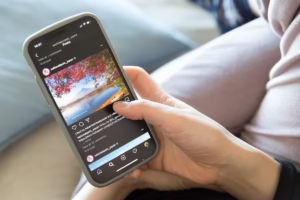
Between the photos of an acquaintance touring temples in Southeast Asia, the beauty routine that the fashion influencer recommends or the interesting story that an old classmate has in his hands, at least one advertisement always slips when scrolling through an Instagram wall. Advertisements on social networks have plagued users for a long time. They are not simple interruptions, as they are part of a carefully designed digital marketing strategy. Its objective is to capture attention, provoke an action, get a sale or at least a click that brings the user one step closer to the brand behind the ad.
And those ads may be more than we realize. A group of scientists has discovered that people do not detect them as well as they thought. And no, it’s not that people are worse at picking up ads. The fact is that the platforms have managed to integrate these better, according to the new study published by the magazine Frontiers and led by researcher Maike Hübner. «I have nephews, and by observing how today’s children and adolescents grow up with a phone in their hand, I noticed how early they are exposed to fake news and advertising on social networks. That was the main motivation for the analysis,» says Hübner, from the University of Twente (Netherlands).
Hübner shared his concerns with other colleagues and students. To their surprise, many of them were also not clear about how much advertising they saw on a daily basis. Some even responded: “Well, I like to stay up to date, I want to feel like I belong.” Given the difficulties people have in distinguishing between real ads and publications, this expert decided to study why it continues to happen.
The scientists invited 152 volunteers who are regular Instagram users to view one of three simulated walls of the app. Each of them was made up of 29 posts: eight ads and 21 organic posts. And they were asked to imagine that the wall was theirs and to navigate it as they normally would.
Hübner and his team recorded eye movements and also evaluated the dwell time on the posts. After each session, scientists interviewed participants about their experience. The results of the analysis, published this Wednesday, reveal that most volunteers were surprised to discover how many ads they had missed. “They were very confident in their ability before the experiment,” he says.
Participants looked at details such as logo design, good quality images or ‘Buy now’ buttons before realizing that the information was real. The researchers found that the ads often went unnoticed, but that if people realized the content was not organic, many stopped interacting with the post. The eye-tracking data suggests that those who paid more attention to those calls to action (like a link to sign up, for example) could be using these elements as a way to identify paid messages.
This was less likely to happen with ads that were better integrated and in a format typical of organic content. If the advertising signals were not immediately noticed, they obtained levels of interaction similar to content that is shared naturally.
Source: www.elpais.com